

Dubai businesses need reliable transport every day. Restaurants receive fresh supplies each morning. Retail stores restock inventory constantly. Construction sites require material deliveries. E-commerce companies promise same-day shipping. All these operations depend on one thing: flexible vehicle rental.
1 ton pickup truck rental in Dubai solves this challenge perfectly. You get a capable vehicle when you need it. No buying expensive trucks. No maintenance headaches. No worrying about breakdowns. Just reliable transport that keeps your business moving.
This guide explains everything about renting pickups in Dubai. You’ll learn the rental process step by step. Discover which businesses benefit most. Understand short-term versus long-term options. See real logistics examples from Dubai companies.
Already know pickup basics? Our complete 1 ton pickup truck in UAE guide covers vehicle specifications and capabilities.
Understanding 1 Ton Pickup Truck Rental Services
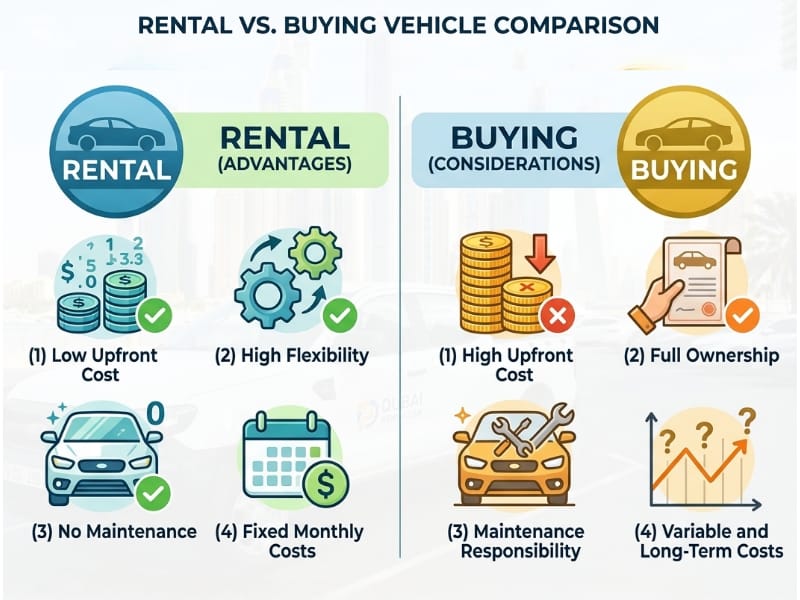
Pickup truck rental means borrowing a vehicle for a set time. You pay daily, weekly, or monthly fees. The rental company maintains the truck. You focus on your business.
Think of it like renting an apartment instead of buying a house. You get what you need without huge upfront costs. When your needs change, your rental changes too.
Why Businesses Choose Rental
Flexibility wins: Your delivery volume changes. Summer might be slow. Ramadan gets crazy busy. Rentals let you scale up or down instantly.
Cost control matters: Buying a truck costs AED 80,000-120,000. Plus insurance, maintenance, and parking. Renting costs AED 300-450 daily or AED 3,000-6,500 monthly. You save capital for other business needs.
No maintenance stress: The rental company fixes problems. Your truck breaks down? They bring a replacement. You never lose delivery days.
What You Get
Standard 1 ton pickup rentals include:
- Toyota Hilux or a similar reliable truck
- Valid insurance coverage
- 24/7 roadside assistance
- Clean, maintained vehicle
- Basic fuel tank (full)
What you pay separately:
- Fuel for your deliveries
- Salik toll gate charges
- Parking fees
- Any traffic fines
Step-by-Step Guide to Renting a 1 Ton Pickup
Renting a 1 ton pickup truck in the UAE is usually a straightforward process, but understanding the steps helps businesses avoid delays and unexpected charges. Most rental providers follow a similar procedure, from document verification to vehicle inspection and contract signing. The steps below explain how the typical pickup rental process works for businesses in Dubai, Sharjah, and Abu Dhabi.
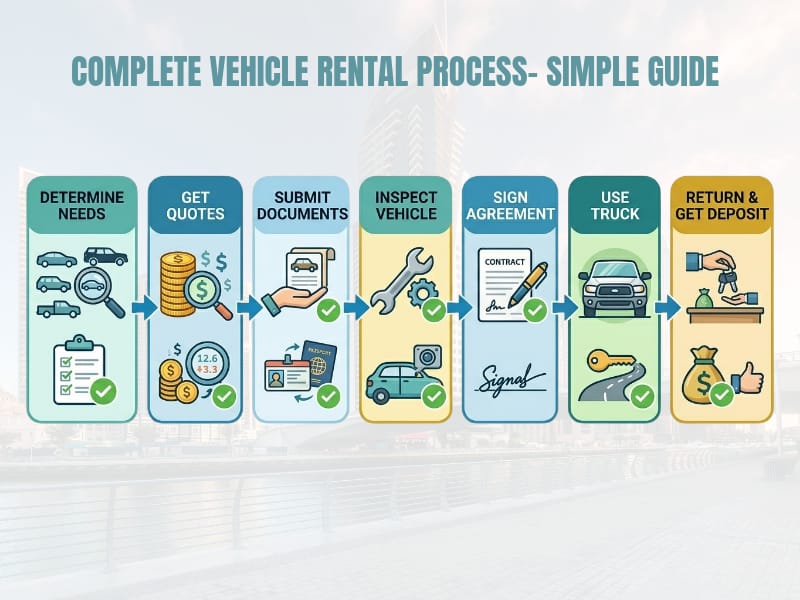
Step 1: Determine Your Needs
Before calling rental companies, answer these questions:
How many days will you use the truck?
1-3 days = Daily rental
1-4 weeks = Weekly rental
1+ months = Monthly rental
What will you carry?
Dry goods and equipment = Standard pickup
Fresh food and perishables = Chiller van needed
Ice cream and frozen items = Freezer van required
How far will you drive daily?
Under 200 km = Standard package
Over 300 km = Unlimited mileage package
Do you have a driver?
Yes = Self-drive rental
No = Rental with driver service
Step 2: Get Quotes
Contact 3-5 rental companies. Provide clear information:
- Rental duration needed
- Expected daily mileage
- Delivery area (Dubai only or other emirates)
- Any special requirements
Compare quotes carefully. Cheapest isn’t always best. Check what’s included. Ask about hidden fees.
Step 3: Submit Documents
Rental companies need:
- Valid UAE driving license (minimum 1 year old)
- Emirates ID copy
- Credit card for security deposit
- Company trade license (for business rentals)
- Contact number
The process usually takes 30 minutes. Some companies approve the same day.
Step 4: Inspect the Vehicle
Never skip this step. Check before you drive away:
Outside the truck:
Tire condition (tread depth)
Body damage or dents
All lights working
Mirrors are clean and intact
License plates attached
Inside the cabin:
Air conditioning works
No warning lights on the dashboard
Seat belts functional
Clean interior
Cargo bed:
No sharp edges
Tailgate operates smoothly
Tie-down points work
Take photos of any existing damage. You won’t get charged for it later.
Step 5: Sign Agreement
Read the rental contract completely. Understand:
- Exact rental period and return date
- Total cost breakdown
- Mileage limits and excess charges
- Insurance deductible amount
- Fuel policy (full-to-full standard)
- Late return penalties
Ask questions about anything unclear. Don’t sign until you understand everything.
Step 6: Start Using the Truck
Before your first delivery:
Adjust mirrors and seat
Test brakes in the parking area
Set GPS for your route
Save the emergency contact number
Confirm return location
During rental:
Drive safely always
Park in legal areas only
Secure cargo properly
Report any problems immediately
Keep the truck reasonably clean
Step 7: Return Process
On return day:
Refuel to a full tank (keep receipt)
Clean the cargo bed of debris
Remove all personal items
Return on time (late fees apply)
Complete final inspection with staff
Security deposit returns within 7-10 days usually. Traffic fines are deducted from the deposit if any occur.
Who Rents 1 Ton Pickup Trucks in Dubai
Dubai’s fast-moving commercial environment depends heavily on flexible transport solutions. Many small and medium businesses prefer renting 1 ton pickup trucks because they provide the right balance between cargo capacity and city mobility.
Retail and E-Commerce Businesses
Retailers and online sellers use 1 ton pickups to move products from warehouses to customers across Dubai. The vehicle size is ideal for transporting electronics, home appliances, packaged goods, and general merchandise while navigating busy commercial areas.
Food and Beverage Companies
Restaurant suppliers deliver ingredients each morning. Canned goods, dry ingredients, and equipment travel in standard pickups. Fresh meat and dairy need our refrigerated truck services.
Bakeries distribute bread and pastries to cafes. Morning routes start at 5 AM. Packaged items travel fine in regular pickups. Cream-filled items need temperature control.
Catering companies transport tables, chairs, and serving equipment. Event setups happen days before. Pickups move everything efficiently.
Warehouse and Distribution Transfers
Many companies use pickup trucks for short-distance logistics between warehouses, storage units, and retail outlets. Industrial zones such as Al Quoz, Jebel Ali, and Dubai Investment Park rely heavily on flexible pickup transport for quick stock transfers.
Startups and Small Businesses
New companies test business models. Don’t know if the delivery demand will grow. Renting prevents expensive vehicle purchases. Seasonal businesses operate during specific months. Gift shops peak at holidays. School suppliers surge in August. Rent only when needed.
Choosing Between Short-Term and Long-Term Pickup Rental
Businesses in Dubai choose different rental durations depending on how frequently they need a vehicle. Some companies require a truck only for a few days, while others rely on pickups for daily deliveries. Understanding when to choose daily, weekly, monthly, or annual rentals helps control transport costs and improve operational efficiency.
Daily Rental
Daily rental works best for very short-term needs. Businesses usually choose this option when they need a temporary backup vehicle or when handling a one-time delivery.
Common situations include:
- A regular company vehicle breaks down, and deliveries must continue
- A client places a large one-time order requiring extra transport
- A company wants to test a delivery service before committing to it long-term
- Businesses need extra vehicles during peak sales periods, such as Black Friday or promotional events
In Dubai, daily rental prices usually range between AED 300 and AED 450 per day. This option is practical for 1–5 days, but it becomes expensive if used frequently.
Weekly Rental
Weekly rental is suitable for short projects or temporary increases in delivery demand. It offers more flexibility than monthly contracts while reducing the cost compared with daily rentals.
Businesses often choose weekly rentals for:
- Short-term projects lasting two to three weeks
- Trade shows, exhibitions, or event setups
- Temporary seasonal demand, such as Ramadan or back-to-school periods
- Pilot programs where companies test a delivery route before expanding
Weekly rental typically costs AED 1,500 to AED 2,500 per week, which is usually 20–30% cheaper than paying daily rates.
Monthly Rental
Monthly rental is the most cost-effective option for businesses that operate regular delivery routes.
Companies benefit from monthly contracts when they:
- Deliver goods to customers every day
- Manage scheduled supply routes
- Need a vehicle for 15 or more days per month
Monthly rental prices usually range between AED 3,000 and AED 6,500, depending on vehicle type and provider. This often reduces the effective daily cost to AED 115–250 per day, creating significant savings compared with daily rentals.
Another advantage is operational efficiency. Drivers become familiar with the same vehicle, loading becomes faster, and rental companies often prioritize long-term clients when providing support or replacement vehicles.
Annual Rental Contracts
Large businesses with consistent logistics needs sometimes choose annual rental agreements. These contracts help companies stabilize costs and avoid seasonal price increases. Annual rentals are common for:
- Established companies with continuous delivery operations
- Businesses that require multiple vehicles throughout the year
- Companies managing fleets of five to ten pickup trucks
Long-term contracts often provide 20–25% discounts compared with monthly rates, along with additional benefits such as priority support and dedicated fleet availability.
Rental Duration Comparison
| Duration | Best For | Daily Cost | Flexibility |
| Daily | 1-5 days, emergencies | AED 350-450 | Maximum |
| Weekly | 1-4 weeks, short projects | AED 215-360 | High |
| Monthly | Regular operations | AED 115-250 | Medium |
| Annual | Established business | AED 95-180 | Low |
Temperature-controlled transport plays an essential role in many industries across Dubai, Sharjah, and Abu Dhabi. Businesses that handle perishable or temperature-sensitive products often rely on chiller vans and freezer trucks to maintain product quality during transportation. The following examples show how different companies use refrigerated transport to manage their logistics operations efficiently.
Case Study 1: Food Distribution Company
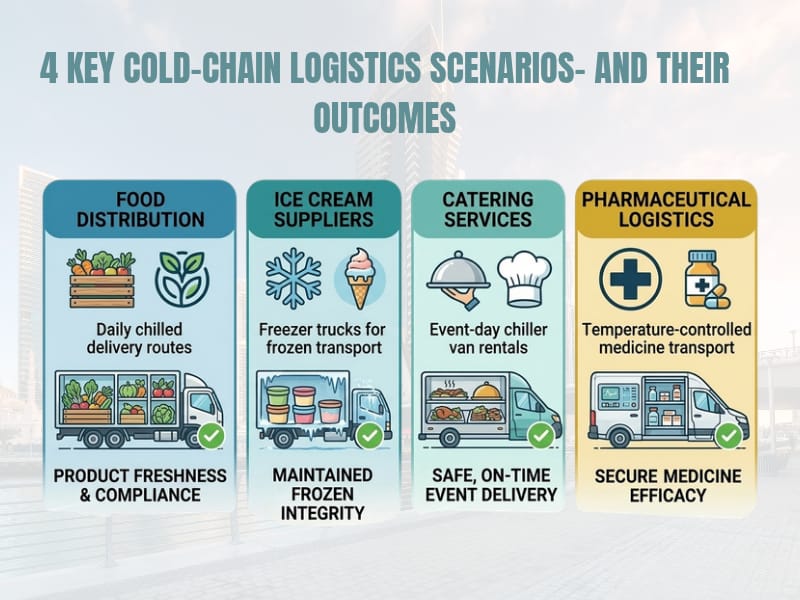
Business: Restaurant ingredient supplier serving multiple restaurants in Dubai
Challenge:
Fresh meat, dairy products, and vegetables needed to be delivered daily while maintaining proper temperature control during transport. Using standard vehicles caused spoilage risks and food safety concerns, especially during Dubai’s high summer temperatures.
Solution:
The distributor started using Polar Freights’ chiller van rental service for daily delivery routes across areas such as Business Bay, Jumeirah, and Dubai Marina. Temperature-controlled vehicles maintained the cold chain throughout the delivery process.
Result:
Product freshness improved, food safety compliance was maintained, and restaurants received reliable early-morning deliveries without spoilage or delays.
Case Study 2: Ice Cream and Frozen Dessert Supplier
Business: Ice cream and frozen dessert wholesaler supplying supermarkets in Dubai
Challenge:
Frozen products needed to remain below -18°C during transport. Regular vehicles caused temperature fluctuations, which risked melting products and damaging brand reputation, especially during the UAE summer.
Solution:
The company started using Polar Freights’ freezer truck rental service for daily distribution routes between their cold storage facility and retail outlets across Dubai and Sharjah.
Result:
Frozen products maintained stable temperatures throughout delivery. Product loss was eliminated, and distribution efficiency improved during peak summer demand.
Case Study 3: Catering and Event Companies
Business: Corporate catering company handling weddings and business events
Challenge:
Prepared meals, desserts, and beverages had to be transported from the central kitchen to event venues while maintaining freshness and food safety standards.
Solution:
The catering company rented chiller vans from Polar Freights for event days. Temperature-controlled transport ensured food remained within safe storage ranges during delivery.
Result:
Food quality remained consistent, delivery operations became more reliable, and the catering team was able to manage multiple events without transport disruptions.
Case Study 4: Pharmaceutical and Medical Supply Transport
Business: Medical supply distributor delivering temperature-sensitive medicines
Challenge:
Certain medicines and medical supplies require strict temperature control during transportation. Standard transport vehicles risked temperature fluctuations that could compromise product safety.
Solution:
The company adopted refrigerated truck services from Polar Freights for deliveries between medical warehouses, hospitals, and pharmacies across the UAE.
Result:
The distributor maintained proper cold-chain compliance and ensured medicines reached healthcare facilities safely and within required temperature ranges.
Temperature-Controlled Transport: When Pickups Don’t Work
Understanding the Difference
Standard pickup trucks carry cargo at outside temperatures. Dubai summers hit 45°C. Winter mornings drop to 15°C. Your cargo experiences these temperatures.
This works fine for:
- Packaged goods and canned items
- Dry ingredients (flour, rice, sugar)
- Restaurant equipment
- Furniture and building materials
- Electronics (in protective packaging)
This fails for:
- Fresh meat and chicken
- Dairy products (milk, cheese)
- Fresh vegetables and fruits
- Bakery items with cream
- Ice cream and frozen desserts
- Chocolate and confectionery
Legal Requirements
Dubai Municipality enforces strict food safety rules. Transporting perishables without proper refrigeration results in heavy fines. Your business license can get suspended.
According to Dubai Food Safety regulations, fresh food must maintain safe temperatures during transport. This isn’t optional.
The Right Solution
Polar Freights specializes in temperature-controlled logistics. We’ve served Dubai businesses for 17 years. Our fleet includes:
Chiller vans maintain +2°C to +8°C. Perfect for fresh meat, dairy, vegetables, and prepared foods.
Freezer vans keep -18°C to -25°C. Essential for ice cream, frozen foods, and long-term frozen storage.
High-roof chiller vans provide maximum cargo space with temperature control.
Same flexible rental terms: daily, weekly, monthly. Same professional service. Just proper equipment for perishable goods.
Many businesses use both solutions. Standard pickups for dry goods and equipment. Our chiller vans for fresh items. This combination optimizes costs.
Common Rental Mistakes to Avoid
Mistake 1: Not Reading the Contract
Problem: Hidden fees surprise you at return. Mileage limits unclear. Insurance deductible unknown.
Solution: Read every line. Ask questions. Understand total costs upfront.
Mistake 2: Skipping Vehicle Inspection
Problem: Get charged for existing damage you didn’t cause.
Solution: Take photos of every dent and scratch. Document everything before driving away.
Mistake 3: Wrong Rental Duration
Problem: Using daily rentals for 15+ days wastes money.
Solution: Calculate usage days. Switch to weekly or monthly when it saves money.
Mistake 4: Ignoring Mileage Limits
Problem: The limited package allows 200 km/day. You drive 350 km. Excess charges add AED 112.50 daily.
Solution: Track your typical routes. Get unlimited mileage if you exceed limits.
Mistake 5: Using the Wrong Vehicle Type
Problem: Transporting fresh food in regular pickup. Dubai Municipality inspector sees you. AED 15,000 fine.
Solution: Match vehicle to cargo. Temperature-sensitive items need refrigerated transport.
Mistake 6: Late Returns
Problem: Return truck 3 hours late. Get charged a full extra day (AED 350-450).
Solution: Plan a return with buffer time. Dubai traffic delays happen.
Mistake 7: Not Budgeting Hidden Costs
Problem: Think rental costs AED 4,500/month. Actual cost with fuel and tolls reaches AED 6,500.
Solution: Budget for fuel (AED 700), Salik (AED 700), parking (AED 500), and potential fines (AED 200).
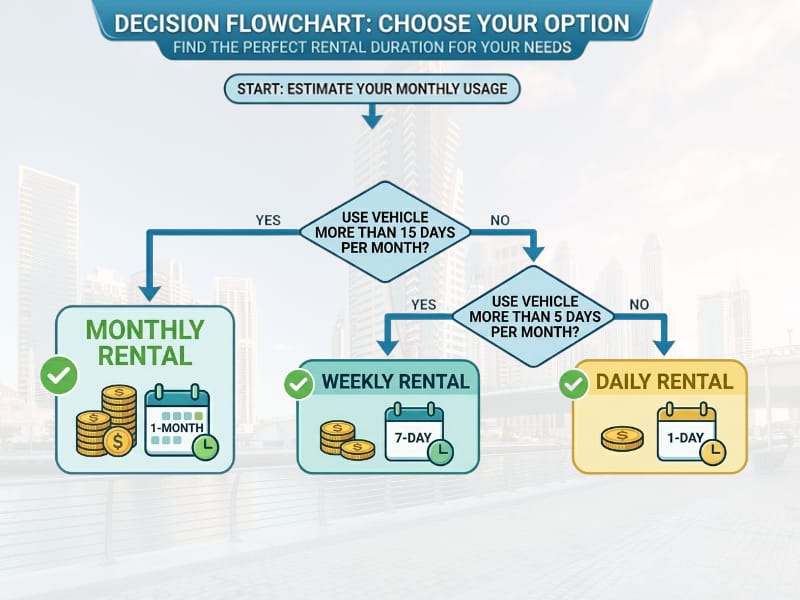
Making Your Rental Decision
Evaluate Your Actual Needs
How many delivery days monthly?
1-5 days = Daily rental
6-15 days = Weekly rental
16+ days = Monthly rental
What’s your cargo?
Dry goods = Standard pickup
Perishables = Temperature-controlled vehicle
How long will this need continue?
Short-term project = Flexible rental
Ongoing operations = Long-term contract
Compare Providers
Get quotes from multiple companies. Check:
- Total cost including all fees
- Insurance coverage details
- Vehicle age and condition
- Customer reviews online
- Response time for problems
Start Small, Scale Smart
Don’t commit to annual contracts immediately. Start with shorter rentals. Test the service. Understand your real usage. Then negotiate better rates for longer commitments.
Conclusion
1 ton pickup truck rentals offer businesses in Dubai a practical and cost-effective transport solution. Companies can move goods without the expense of purchasing and maintaining their own vehicles.
Rental options allow businesses to match vehicle usage with delivery demand. Short-term rentals work well for temporary needs, while long-term contracts provide better value for regular operations.
It is also important to choose the right vehicle for the cargo. Standard pickups are suitable for dry goods, but perishable items such as food, dairy, meat, or frozen products require temperature-controlled vehicles to maintain proper cold-chain conditions.
Businesses should compare rental providers, review pricing and service terms, and select a plan that fits their logistics needs. With the right transport solution, companies can maintain reliable deliveries while keeping operational costs under control.
FAQs
Q-1: How quickly can I rent a pickup truck in Dubai?
Same-day rental is possible if you call before 10 AM. Most companies deliver within 2-3 hours. Bring a valid UAE license and Emirates ID.
Q-2: What happens if the rental truck breaks down?
Call the rental company immediately. Professional providers send a replacement within 1-2 hours. Your rental clock stops during breakdown.
Q-3: Can I use the pickup for both Dubai and Sharjah deliveries?
Yes. Most rentals cover the entire UAE. Check your contract. Cross-emirate travel is usually allowed.
Q-4: Do I need a special license to drive a 1 ton pickup?
No. A regular UAE driving license is sufficient for most 1-ton pickups. The license must be at least 1 year old.
Q-5: Can I rent a pickup for just 4 hours?
Some companies offer hourly rental (minimum 4 hours). Most prefer a full 24-hour day rental. Check with the provider.
Q-6: What if I need to extend my rental?
Call the rental company before the original return date. Extension is possible if a truck is available. It may cost the same or more.
Q-7: Can someone else drive the rented pickup?
Additional drivers need approval. Must meet the same license requirements. Some companies charge an extra AED 100-150 one-time fee.