The United Arab Emirates runs on efficient logistics. Every day, thousands of businesses move goods across cities. Small and medium enterprises need reliable transport solutions constantly.
Dubai’s economy thrives on speed and efficiency. Sharjah’s industrial zones never sleep. Abu Dhabi’s business districts demand continuous supply chains. These cities require flexible cargo transport options.
1 ton pickup trucks have become essential business tools. They navigate busy streets with ease. Parking stays simple in crowded areas. Operating costs remain manageable for growing companies.
SME Logistics Demand Across UAE (Dubai, Sharjah & Abu Dhabi)
Small and medium businesses across the UAE need flexible transport for daily deliveries, stock transfers, and equipment movement. Traditional logistics services often cost too much or don’t fit SME-sized orders. As e-commerce and fast delivery expectations grow in Dubai, and industrial supply chains stay active in Sharjah and Abu Dhabi, 1 ton pickup trucks remain a practical solution for reliable, on-time business transport.
What Is a 1 Ton Pickup Truck?
A 1 ton pickup truck is a light commercial vehicle designed to carry up to approximately 1,000 kg of payload safely. The term “1 ton” refers to its carrying capacity — not the truck’s own weight.
For businesses, this number defines how much cargo can be transported legally and efficiently across Dubai, Sharjah, and Abu Dhabi.
What Does the 1 Ton Capacity Include?
The payload includes:
- Cargo and materials
- Driver and passengers
- Fuel
- Tools and equipment
It excludes the vehicle’s empty weight.
Each pickup also has a Gross Vehicle Weight Rating (GVWR) — the maximum total weight of the truck plus everything inside it. Exceeding this limit can:
- Lead to UAE traffic fines
- Reduce braking efficiency
- Affect vehicle stability
- Risk insurance claim rejection
Staying within limits protects both compliance and operational safety.
Built for Commercial Work
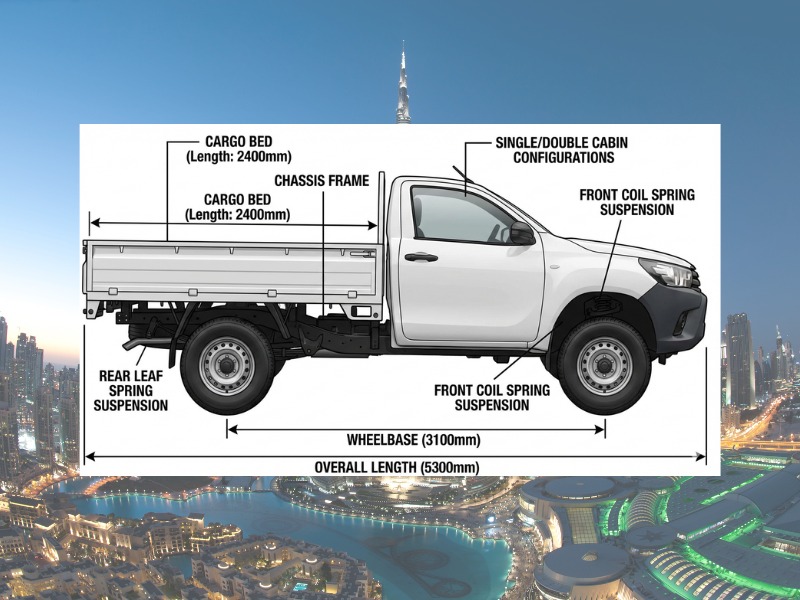
Unlike passenger vehicles, 1 ton pickups are engineered for daily load carrying. Key structural features include:
- Reinforced ladder-frame chassis
- Heavy-duty suspension
- Strengthened rear axle
- Commercial-grade tires
- Enhanced braking systems
The open cargo bed provides flexible loading for goods, equipment, and materials.
Cabin Options for Different Business Needs
Single Cab – Longer cargo bed, seats 2–3. Best for delivery-focused operations.
Extended Cab – Balanced crew and cargo space. Ideal for small service teams.
Double Cab – Seats up to 5. Suitable for transporting workers and tools together.
Popular Models in UAE Market
Toyota Hilux dominates UAE roads. It offers proven reliability and durability. Parts availability stays excellent everywhere. Resale values remain consistent.
Nissan Navara provides modern technology. Comfort levels exceed competitors. Fuel efficiency impresses in city driving. Warranty coverage gives peace of mind.
Mitsubishi L200 balances price and performance. Initial costs stay competitive. Maintenance expenses remain reasonable. Off-road capability helps construction sites.
Ford Ranger delivers powerful engines. Towing capacity exceeds that of many rivals. Interior quality matches that of passenger SUVs. Technology features attract modern businesses.
Isuzu D-Max focuses on commercial duty. Durability proves exceptional in testing. Payload capacity maximizes usefulness. Simple design reduces repair costs.
Difference from Passenger Pickups
Not all pickup trucks are built for the same purpose. Passenger pickups focus on comfort and lifestyle. Commercial pickups focus on durability and daily workload performance. Choosing the wrong type can increase operating costs and reduce long-term reliability.
Commercial pickup features:
- Higher payload ratings
- Simpler interior materials
- Manual transmission options
- Steel wheels (not alloy)
- Basic sound systems
- Commercial warranty terms
Passenger pickup priorities:
- Luxury interior materials
- Advanced entertainment systems
- Automatic transmissions
- Alloy wheels standard
- Chrome exterior trim
- Consumer warranty coverage
Commercial-grade vehicles last longer under stress. They’re designed for daily heavy use. Maintenance intervals account for hard work. Businesses benefit from this durability.
Why 1-Ton Pickup Trucks Dominate SME Transport in UAE
Vehicle choice directly impacts cost, flexibility, and long-term profitability. Larger trucks increase fuel use, insurance premiums, and operating complexity. Smaller vehicles often lack enough payload for commercial work. A 1 ton pickup truck strikes the right balance between capacity and efficiency for businesses operating across Dubai, Sharjah, and Abu Dhabi.
Operational Fit: The 1-ton chiller truck for rent in Dubai typically supports 800–1,000 kg of payload. That range suits daily SME operations such as retail supply runs, warehouse transfers, maintenance services, and equipment transport. At the same time, the vehicle remains compact enough to navigate congested streets in Deira, Business Bay, Al Quoz, and Sharjah Industrial Areas.
Cost Efficiency: Unlike heavier trucks, a 1-ton pickup usually requires only a regular UAE driving license. This reduces hiring complexity and keeps staffing flexible. Insurance premiums also remain more affordable compared to 3-ton commercial trucks, which significantly increase yearly operating costs.
1 Ton vs Other Commercial Vehicle Categories
| Vehicle Type | Payload Capacity | Operational Cost | License Requirement | Suitable For |
|---|---|---|---|---|
| ½ Ton Pickup | 500–700 kg | Low | Regular | Light occasional deliveries |
| 1 Ton Pickup | 800–1,000 kg | Moderate | Regular | Daily SME logistics |
| 3 Ton Truck | 2,500+ kg | High | Heavy license | Bulk transport |
For most SMEs, the 1-ton pickup sits in the “practical zone.” It offers sufficient cargo capacity without crossing into heavy commercial regulations or incurring higher operational expenses.
In daily operations, these vehicles handle:
- retail restocking
- warehouse inventory movement
- technician equipment transport
- construction material supply for small sites
Instead of investing in oversized fleets, many businesses choose 1-ton pickups because they maintain delivery speed while controlling fuel and insurance costs.
If your cargo requires temperature control, such as fresh meat, dairy, or pharmaceuticals, a refrigerated vehicle becomes necessary. In that case, a chiller van rental in Dubai is the better option than a standard pickup.
Related reading: For businesses needing temperature-controlled transport, explore our chiller van rental services as an alternative solution.
LLoad Capacity and Specifications of a 1 Ton Pickup
[OPENING HOOK – NEW] Every business owner asks the same question: “How much can this truck actually carry?” The answer isn’t just a number on a spec sheet. Real-world payload depends on fuel levels, driver weight, tools, and even Dubai’s summer heat affecting tire pressure. Let’s break down what actually matters.
Understanding Real Payload Capacity
Standard 1-ton pickups advertise 800-1,000 kg capacity. Heavy-duty variants reach 1,200 kg. But here’s what rental companies won’t always tell you upfront.
The Math That Matters:
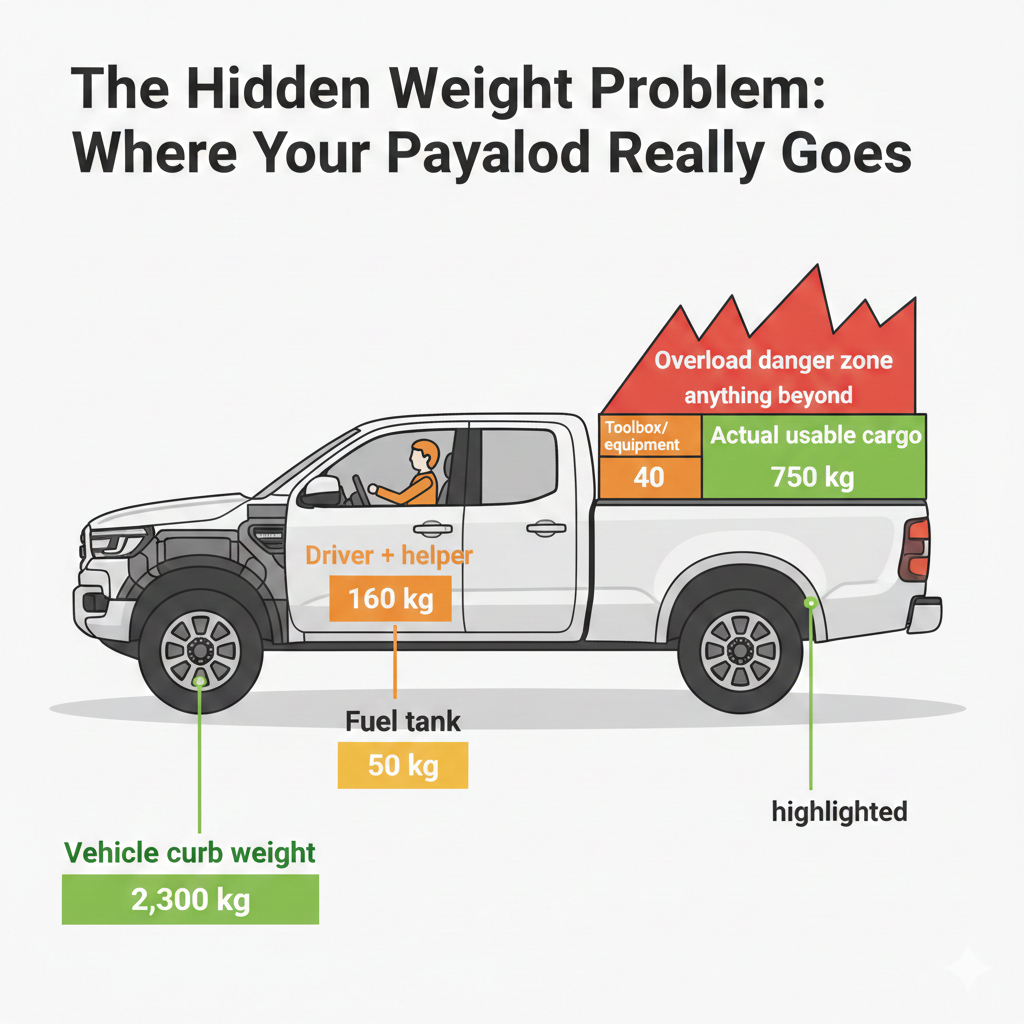
Your pickup’s GVWR (Gross Vehicle Weight Rating) is 3,500 kg. The vehicle itself weighs 2,300 kg empty. Simple subtraction gives you 1,200 kg payload capacity. But you’re not done calculating yet.
A full diesel tank adds 50 kg. You and your helper together weigh approximately 160 kg. That heavy-duty toolbox bolted to the bed? Another 40 kg. Suddenly, your “1,000 kg capacity” drops to 750 kg of actual usable cargo space.
Why this calculation protects your business: Dubai Police enforces weight limits strictly. RTA inspections target commercial vehicles regularly. Overloading fines start at AED 3,000. More importantly, overloaded vehicles handle poorly, brake more slowly, and wear out faster. Insurance claims get rejected if accident investigations reveal overloading.
Cargo Bed: Size Really Does Matter
Bed dimensions determine what you can actually transport. A single-cab pickup gives you roughly 1.8-2.0 meters of length. Double-cab configurations sacrifice 30 cm for rear passenger seats, dropping to 1.5-1.7 meters. Width stays consistent at 1.5-1.6 meters across models.
Here’s where it gets practical: Euro pallets measure 1200 x 800 mm. You can fit two side-by-side in a single cab. Stack carefully, and you might squeeze three or four, but remember your weight limits. GCC standard pallets (1200 x 1000 mm) fit two lengthwise. Double cabs struggle with pallet loads; you’re limited to one or two at most.
| Bed Configuration | Length | Width | Volume | Pallet Capacity |
|---|---|---|---|---|
| Single Cab | 1.8-2.0 m | 1.5-1.6 m | 1.2-1.4 m³ | 2-4 Euro pallets |
| Double Cab | 1.5-1.7 m | 1.5-1.6 m | 1.0-1.2 m³ | 1-2 pallets max |
The difference between 1.8m and 1.5m doesn’t sound dramatic until you’re trying to load steel pipes, lumber, or assembled furniture. That extra 30 cm often means the difference between one trip and two.
Fuel Efficiency: The Real Cost Nobody Talks About
Everyone focuses on rental rates. Smart businesses calculate fuel costs first. In Dubai’s stop-and-go traffic, diesel pickups average 10-12 km per liter. Highway driving jumps to 14-16 km/liter. Your realistic average? About 11-13 km/liter for mixed city-highway use.
Loaded trucks consume 15-20% more fuel. That’s the hidden tax of carrying cargo. Petrol variants drink even faster—8-10 km/liter in the city, maybe 12-14 on highways.
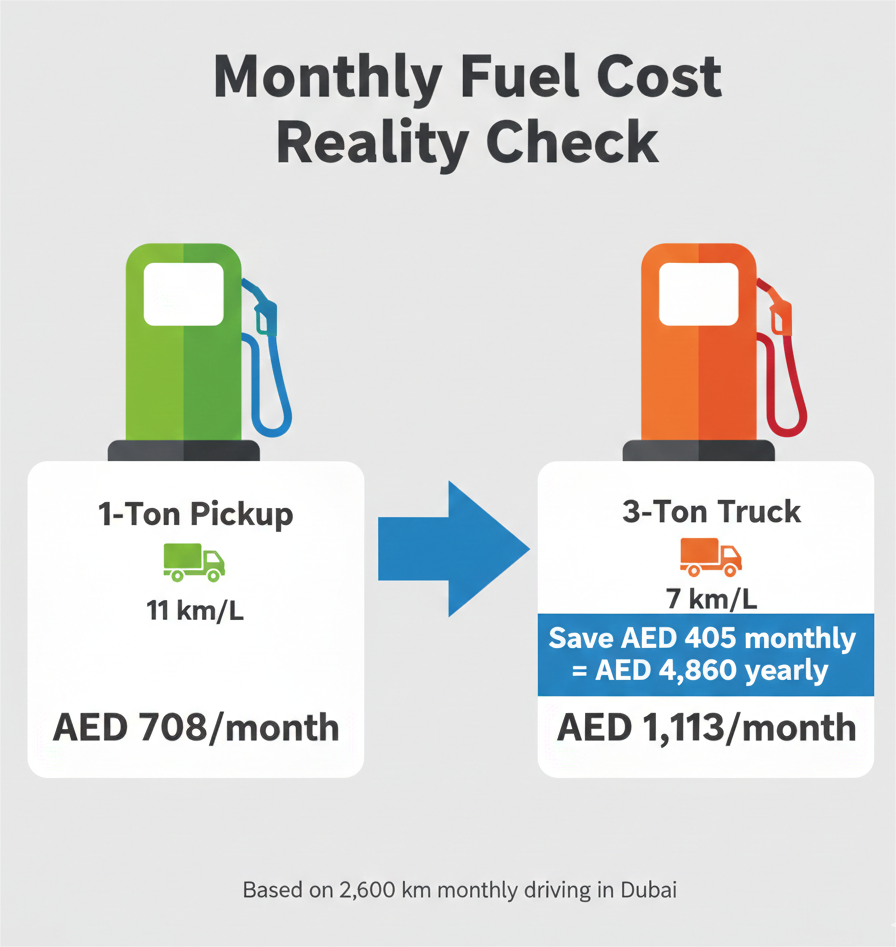
Real monthly calculation: Your delivery route covers 100 km daily. Work 26 days monthly. That’s 2,600 km. At 11 km/L efficiency, you’ll burn 236 liters. Diesel currently costs AED 3.00/liter. Your monthly fuel bill: AED 708.
Compare this to a 3-ton truck getting 6-9 km/L. Same 2,600 km route needs 371 liters. That’s AED 1,113 monthly—AED 405 more expensive just for fuel. Over a year, fuel savings alone justify choosing the right-sized vehicle.
Why Pickups Win in Dubai’s Urban Jungle
Turning radius tells the whole story. A 1-ton pickup needs 5.5-6.5 meters to complete a U-turn. Three-ton trucks need 8-10 meters, that’s 30-40% more space. In Dubai Marina’s tight residential streets, that difference isn’t academic. It’s the gap between completing your delivery and blocking traffic while you reverse three times.
Customer driveways accommodate pickups easily. Villa compounds with speed bumps don’t faze them. Shopping mall underground parking has height barriers at 2.1 meters, no problem when your pickup stands 1.7-1.8 meters tall. Business Bay’s premium parking fees are charged by vehicle size. Standard space rates beat oversized truck rates every time.
Ground clearance saves you money, too. UAE roads feature speed bumps everywhere. Construction zones create temporary rough patches. Standard pickups offer 200-230 mm clearance. 4×4 variants give you 230-280 mm. That’s 50-80 mm higher than cargo vans. Your exhaust system, oil pan, and transmission stay protected. Repair bills stay low.
Loading Smart: Weight Distribution Basics
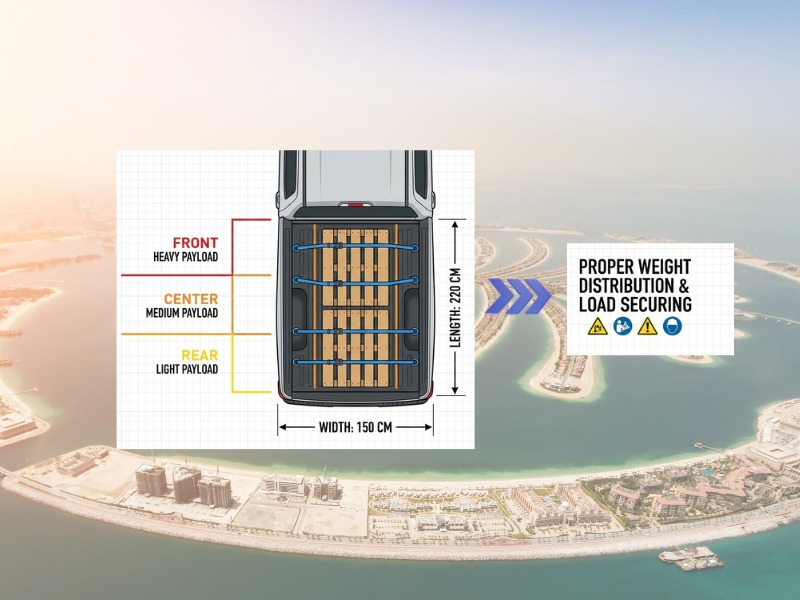
Professional drivers know this instinctively. Heavy items go forward, near the cabin. This keeps the weight over the front axle, where steering happens. Distribute weight evenly side-to-side to prevent rollovers. Secure everything with proper straps; cargo shifting mid-turn causes accidents.
The physics of bad loading: Rear-heavy loads reduce front tire grip. Your steering becomes vague and unresponsive. Braking efficiency drops because the weight transfers backward. Side-heavy cargo raises your center of gravity. Sudden lane changes risk tipping. None of this is theoretical; Dubai Police accident reports cite improper loading regularly.
Quick safety check before driving:
- Heavy items near the cabin? ✓
- Weight balanced left-right? ✓
- All cargo strapped down? ✓
- Tire pressure checked? ✓
- Nothing extending beyond the bed? ✓
Towing Capability: The Bonus Feature
Many pickups tow 2,500-3,500 kg with braked trailers. Unbraked trailer limits drop to 750 kg. Tongue weight (downward pressure on hitch) maxes around 250-350 kg, depending on the model.
This capability matters for businesses that occasionally need equipment mobility. Small excavators reach construction sites. Generators are transported to outdoor events. Tool trailers follow HVAC crews between jobs. You’re not buying a dedicated tow vehicle; you’re getting occasional towing as a bonus.
Important RTA requirement: Combined weight (payload + trailer) cannot exceed GVWR. You can’t load 800 kg in the bed and tow a 3,000 kg trailer simultaneously. Heavy trailer towing requires proper licensing. Check regulations before attempting it.
| Towing Scenario | Braked Trailer | Unbraked Trailer | License Required |
|---|---|---|---|
| Equipment trailer (empty) | 2,500 kg ✓ | 750 kg ✓ | Standard UAE license |
| Small excavator + trailer | 3,500 kg ✓ | Not suitable | Check with RTA |
| Generator on wheels | 2,000 kg ✓ | 600 kg ✓ | Standard UAE license |
| Tool trailer (loaded) | 1,500 kg ✓ | 750 kg max | Standard UAE license |
These specifications aren’t just numbers for spec sheets. They’re the difference between profitable operations and constant vehicle problems. Understanding the real payload prevents overloading fines. Calculating fuel efficiency accurately predicts monthly costs. Knowing the turning radius helps with route planning through Dubai’s congested areas. Master these basics, and you’ll choose the right vehicle every time.
Important note: Combined weight (payload + trailer) has limits. Never exceed GVWR regardless of towing capacity. RTA regulations require proper licensing for heavy trailers.
Industries That Use 1 Ton Pickup Trucks in UAE
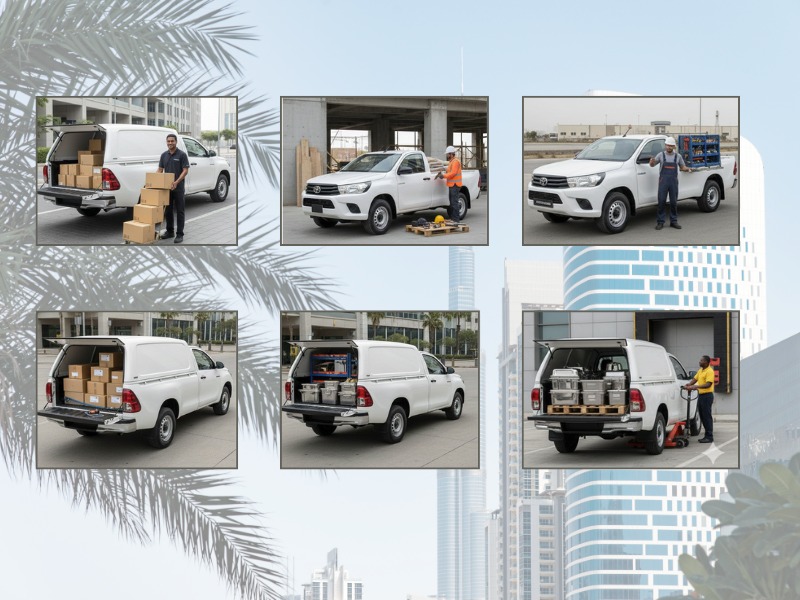
Multiple business sectors depend on pickup trucks daily. Each industry has unique requirements and challenges. Understanding applications helps businesses optimize operations.
Retail Delivery Services
Retail businesses form UAE’s economic backbone. Stores need constant inventory replenishment. Customer expectations demand reliable delivery.
Supermarket Operations:
Major chains operate central distribution hubs. Smaller branches receive daily restocking. Fresh produce arrives early morning. Frozen items need multiple deliveries.
Independent grocers use pickups for procurement. They visit wholesale markets in Deira and Al Aweer. Multiple stops happen per trip. Return journeys carry sold items.
Daily operations include:
- Morning warehouse loading
- First delivery wave
- Second wave
- Evening deliveries
- Same-day service pressure
Social Commerce Growth:
Instagram sellers ship from home offices. Small warehouse operations fulfill orders. Pickup rentals handle peak periods. Flexibility prevents overstaffing.
Ramadan sees massive volume increases. Back-to-school season creates surges. Black Friday demands extra capacity. Rental pickups provide scalability.
Catering and Food Supply Chain
UAE’s hospitality industry operates 24/7. Hotels, restaurants, and events need constant supplies. Food service logistics require specialized handling.
Restaurant Supply Deliveries:
Morning deliveries bring fresh ingredients. Vegetables arrive from Al Aweer market. Meat comes from approved suppliers. Dry goods ship from wholesalers.
Note on temperature control: While some dry goods and equipment can use regular pickups, temperature-sensitive items like fresh meat, dairy products, seafood, and prepared foods require specialized refrigerated transport. Polar Freights’ 1 ton chiller vans ensure food safety compliance for perishable deliveries.
Catering Equipment Transport:
Event caterers move equipment constantly. Chafing dishes, serving platters, and tables travel daily. Set-up teams arrive hours before events. Breakdown happens late evening.
The wedding season (October-April) creates peak demand. Corporate events happen year-round. Hotel banquets require precise timing. Reliable transport ensures success.
Bakery Distribution:
Fresh bread requires early morning delivery. Pastries reach cafes before opening. Cakes are transported to event venues. Packaging prevents damage carefully.
Temperature considerations apply to certain items. Cream-based products need cool conditions. Chocolate decorations melt in Dubai’s heat. Smart businesses use appropriate vehicles.
Warehouse and Distribution Operations
Industrial zones operate continuously. Goods move between facilities constantly. Efficient internal logistics maintains flow.
Inter-Warehouse Transfers:
Large companies operate multiple warehouses. Inventory redistribution happens daily. Stock rebalancing prevents shortages. Emergency transfers solve problems.
Jebel Ali logistics example:
- The central warehouse coordinates supply
- Satellite facilities serve regions
- Daily transfers balance inventory
- Pickup trucks handle smaller loads
- Larger trucks move bulk shipments
Last-Mile Distribution:
Wholesalers serve retail customers. Small shop orders reach AED 500-2,000. Full truckloads aren’t economical. Pickups optimize these deliveries. According to Dubai Municipality regulations, licensed contractors must maintain proper equipment transport. Service vehicles require regular inspections. Compliance ensures continued operation.
Route planning considerations:
- Group orders by location
- Optimize delivery sequence
- Account for traffic patterns
- Schedule around receiving hours
- Confirm orders before departure
Table: Industry Applications Summary
| Industry | Common Cargo | Daily Frequency | Peak Seasons |
| Retail | Groceries, electronics, furniture | Multiple trips | Ramadan, holidays |
| E-commerce | Packages, parcels, returns | 20-50+ deliveries | Black Friday, sales |
| Catering | Equipment, supplies (non-perishable) | 2-5 events | Wedding season |
| Construction | Materials, tools, equipment | Continuous | Development booms |
| Maintenance | Tools, parts, equipment | On-demand | Summer (HVAC) |
| Warehousing | Goods, inventory, transfers | Continuous | Year-round |
| Equipment Rental | Tools, machinery, event items | Daily pickup/return | Weekends, events |
Business Locations Where Pickup Trucks Are Commonly Used
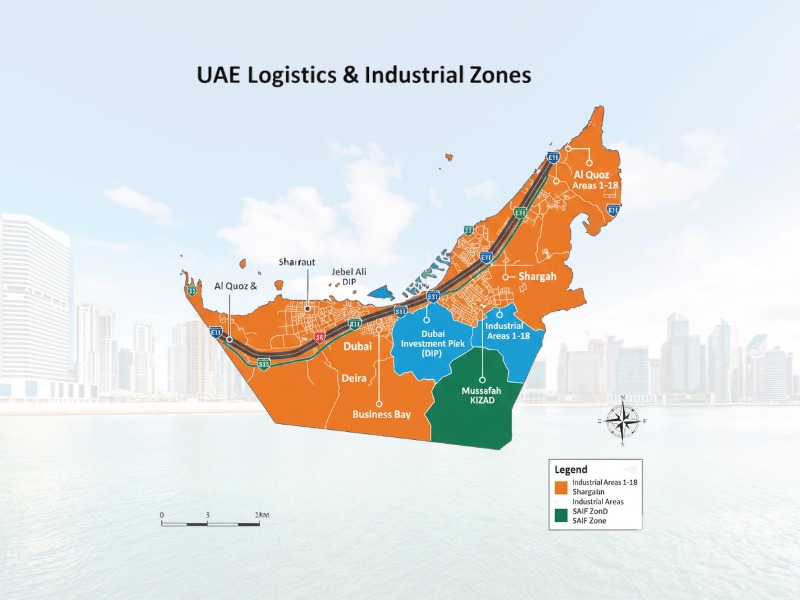
Location determines efficiency. A 1 ton pickup truck performs differently in Deira’s narrow lanes than in Jebel Ali’s industrial grids. Understanding how each business zone operates helps you reduce delays, fuel waste, and delivery errors. Let’s break it down city by city.
Dubai: High-Density Commercial Movement
Dubai functions like multiple micro-cities connected by highways. Each district creates a different transport challenge.
Al Quoz: Compact Industrial Operations
Al Quoz blends manufacturing, warehousing, showrooms, and service workshops within tight road networks. Lanes are narrow. Loading docks face the street. Parking is limited during peak hours.
This is where 1-ton pickups outperform larger trucks. Their tighter turning radius allows quick entry into warehouse clusters. Drivers familiar with the zone complete more stops per day because maneuvering is easier. Most deliveries here involve:
- furniture movement
- automotive parts
- construction supplies
- printing materials
- packaged goods
Peak hours typically run between 8 AM and 11 AM, when supplier traffic is highest. Early arrival reduces congestion delays. Some food processors in this area require temperature-controlled transport, but general goods move efficiently using standard pickups.
Deira: Where Size Matters
Deira remains one of the most complex delivery zones in Dubai. One-way streets, high pedestrian traffic, and limited parking make oversized trucks impractical. In many streets, only compact commercial vehicles can enter safely. A 1-ton pickup offers:
- easier access to wholesale markets
- faster unloading in tight shopfronts
- less obstruction during short stops
Delivery timing becomes critical. Early morning arrivals improve turnaround speed. Midday congestion slows operations significantly. For traders dealing in electronics, spices, textiles, or hardware, vehicle agility directly impacts productivity.
Jebel Ali & JAFZA: Industrial Scale Efficiency
Jebel Ali operates at a different scale.
Wide roads, structured loading docks, and controlled entry points make movement smoother. Security procedures and scheduled deliveries are common inside JAFZA. Here, the 1-ton pickup serves a different role: inter-facility transfers, urgent part deliveries, and smaller batch movements that don’t justify larger trucks. Manufacturers often use pickups for:
- urgent component replacement
- internal warehouse balancing
- sample or partial-load shipments
Because the port and warehouses sit close together, short-distance efficiency becomes more important than high payload capacity.
Dubai Investment Park (DIP): Planned Logistics
DIP’s grid layout improves navigation. Clear signage and separated traffic flows allow consistent delivery timing. For SMEs operating in light manufacturing or distribution, pickups maintain steady internal supply chains without the cost of heavier vehicles.
Modern infrastructure here favors predictable routing, which reduces fuel consumption and missed delivery windows.
Business Bay: Corporate Access Restrictions
Business Bay introduces a different challenge: controlled building access. Height restrictions in underground parking, designated delivery hours, and security clearance requirements limit vehicle options. A 1-ton pickup fits standard parking spaces and avoids many access barriers that affect larger commercial trucks. Common uses here include:
- office supply delivery
- IT equipment transport
- corporate catering
- maintenance visits
In this environment, professional appearance and compact vehicle size matter as much as payload.
Sharjah: High-Volume Industrial Activity
Sharjah’s industrial zones function as the backbone of UAE manufacturing. Activity is constant, and supplier movement is frequent.
Sharjah Industrial Areas (1–18)
These zones contain dense clusters of auto parts, furniture factories, food processors, textile workshops, and trading companies. Road conditions vary. Parking is informal. Traffic peaks around midday and late afternoon. Here, pickups dominate because they:
- move quickly between small factories
- handle frequent short-distance supplier trips
- manage mixed cargo loads
Delivery planning works best during early morning hours when congestion remains lower.
SAIF Zone: Speed and Compliance
Sharjah Airport Free Zone serves importers and export-oriented businesses. Cargo often moves from air freight terminals to distribution centers within hours. Pickups handle:
- final-mile distribution
- urgent document transport
- small-batch shipments
When goods require refrigeration, specialized vehicles become necessary, but for general cargo, 1-ton pickups provide cost-efficient internal movement.
Abu Dhabi: Structured Industrial Logistics
Abu Dhabi’s business districts are more formally organized. Industrial and commercial areas are clearly separated.
Mussafah: Heavy Industrial Core
Mussafah contains steel traders, engineering workshops, oil & gas suppliers, and construction material providers. Wide roads make access easier than in older districts in Dubai. However, the distance between facilities can be significant. Pickups serve:
- tool transport between workshops
- material supply to job sites
- internal business transfers
Efficient route planning is important given the scale of the industrial area.
KIZAD: Modern Industrial Planning
KIZAD supports aluminum, automotive, food processing, and logistics industries within structured transport systems. Scheduled deliveries and organized truck routes dominate this zone. Larger trucks handle bulk cargo, but pickups manage smaller shipments and urgent supply movements.
This balance allows businesses to avoid unnecessary heavy-vehicle expenses.
Abu Dhabi City Center: Controlled Commercial Access
In central Abu Dhabi, vehicle access requires planning. Government buildings and corporate towers often demand scheduled delivery windows and proper documentation. Compact pickups reduce entry complications and fit within restricted parking structures. For:
- office installations
- document transfer
- catering services
- maintenance contracts
Vehicle size directly affects operational smoothness.
Why Location Strategy Matters
The same 1-ton pickup performs differently depending on where it operates.
In Deira, maneuverability saves time.
In Al Quoz, tight turning improves dock access.
In Jebel Ali, short-haul efficiency reduces cost.
In Mussafah, distance management affects fuel use.
Understanding local traffic patterns, delivery timing, and access restrictions allows businesses to maximize vehicle efficiency. When route planning aligns with vehicle capabilities, daily operations become faster, safer, and more profitable.
When Businesses Should Use a 1 Ton Pickup
The wrong vehicle choice costs businesses thousands monthly. Too small means multiple trips eating fuel and time. Too large means wasted capacity and parking nightmares. Here’s exactly when a 1-ton pickup becomes your profit-protecting workhorse.
Practical Use Cases
| Business Scenario | Why a 1-Ton Pickup Works | Example |
|---|---|---|
| Short-Distance Urban Delivery | Easy parking, tight turning radius, lower fuel cost | Retail restocking in Deira or Business Bay |
| Multiple Daily Stops | Quick loading/unloading, better maneuverability | E-commerce last-mile delivery |
| Seasonal Demand Surge | Temporary fleet expansion without long-term investment | Ramadan retail spike, Black Friday sales |
| Emergency Backup Vehicle | Immediate replacement during breakdowns | Fleet maintenance downtime |
| Startup or New Market Testing | Flexible rental options reduce capital risk | New maintenance company launch |
| Project-Based Work | Short-term rental fits limited contract duration | 3-month villa renovation project |
| Warehouse Transfers (Small Loads) | Efficient inter-facility movement | Moving inventory between DIP units |
| Service & Maintenance Routes | Carries tools and spare parts efficiently | HVAC, electrical, plumbing services |
When NOT to Use a 1-Ton Pickup
| Situation | Better Option |
|---|---|
| Large bulk cargo over 1,000 kg | 3-Ton Truck |
| Pallet-heavy warehouse distribution | Medium-duty truck |
| Temperature-sensitive cargo | Chiller or freezer vehicle |
A 1 ton pickup performs best in high-frequency, moderate-load operations where flexibility and access matter more than bulk capacity. If your daily route includes tight parking, multiple stops, and variable load sizes, this vehicle category usually delivers the highest operational efficiency.
1 Ton Pickup vs Other Transport Vehicles
Smart vehicle choice saves money and prevents fines. Standard pickups handle dry goods at AED 300 daily. Chiller vans protect perishables at AED 500 daily. The difference? Canned items, packaged snacks, and equipment travel safely in pickups.
Fresh meat, dairy, vegetables, and ice cream legally require temperature control. Use the wrong vehicle and you either waste 40% on unnecessary refrigeration or risk AED 50,000 Dubai Municipality fines plus business closure. Understanding this line protects both profit and license.
Pickup vs Chiller Van: Understanding the Difference
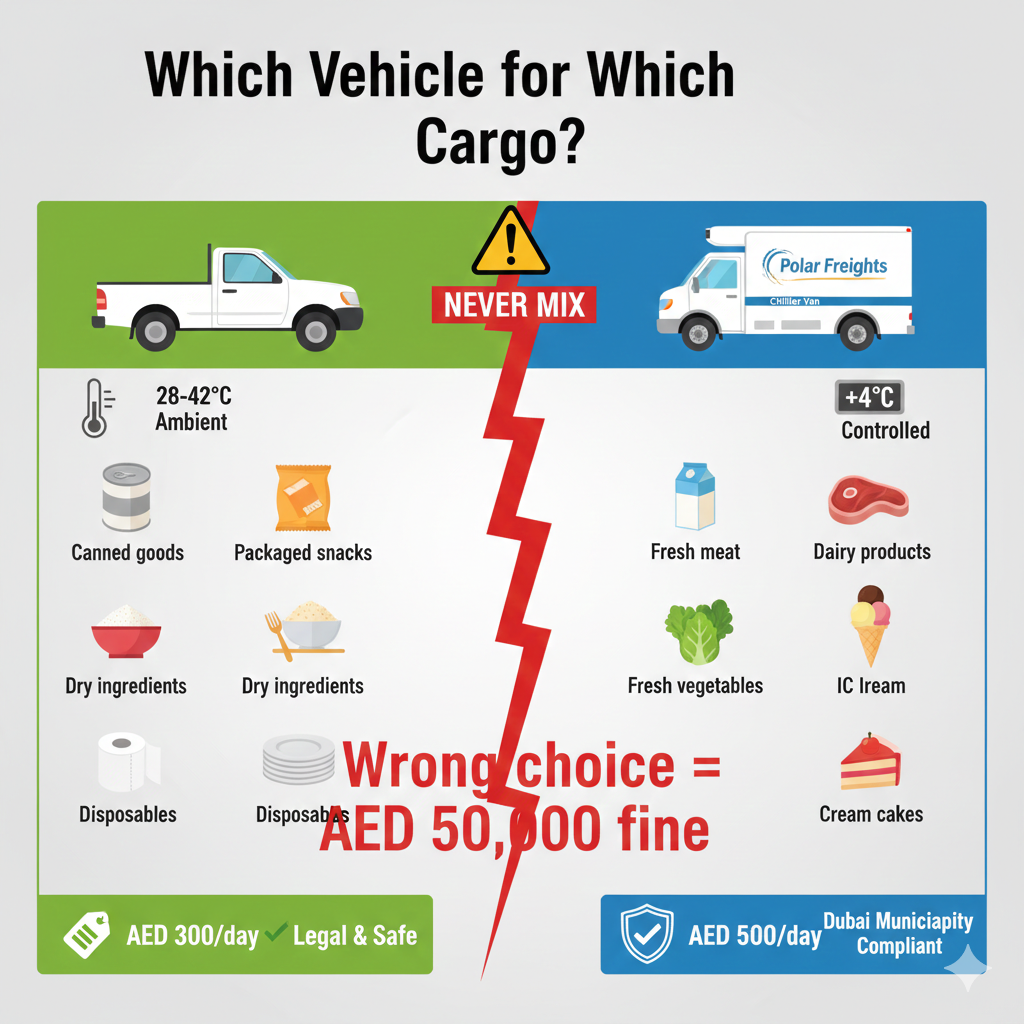
According to the Dubai Municipality Food Safety Department, temperature-controlled transport prevents bacterial growth. Cold chain breaks cause foodborne illness. Compliance protects public health.
Regulatory requirements: UAE food safety laws mandate temperature monitoring. Transport vehicles need calibrated thermometers. Record keeping proves compliance. Violations result in heavy fines.
Temperature ranges explained:
- Chiller: +2°C to +8°C (fresh items)
- Freezer: -18°C to -25°C (frozen goods)
- Ambient: Room temperature (dry goods)
Cost comparison analysis:
| Factor | Regular Pickup | Chiller Van |
| Daily rental | AED 250-350 | AED 400-600 |
| Fuel consumption | Normal | 20-30% higher |
| Maintenance | Standard | Refrigeration adds cost |
| Insurance | Basic | Specialized coverage |
| Applications | General cargo | Perishables only |
PolarFreight’s solution:
Our company specializes in temperature-controlled transport. We operate modern chiller van fleets across the UAE. Food safety compliance guaranteed. Real-time temperature monitoring included.
Pickup vs 3 Ton Truck: Size and Efficiency
Cargo volume determines vehicle needs. Operational costs vary significantly. Understanding differences guides decisions.
Physical Size Comparison:
| Specification | 1 Ton Pickup | 3 Ton Truck |
| Payload capacity | 800-1,000 kg | 2,500-3,000 kg |
| Cargo volume | 1.0-1.4 m³ | 12-16 m³ |
| Length overall | 5.0-5.5 m | 6.5-7.5 m |
| Width | 1.8 m | 2.2-2.4 m |
| Height | 1.7-1.8 m | 2.8-3.2 m |
| Turning radius | 5.5-6.5 m | 8-10 m |
Operational Cost Analysis:
Fuel consumption:
- Pickup: 10-14 km/L (diesel)
- 3-ton truck: 6-9 km/L (diesel)
- Difference: 40-50% higher consumption
Insurance premiums:
- Pickup: AED 2,500-4,000 annually
- 3-ton truck: AED 5,000-8,000 annually
- Difference: 100% more expensive
Maintenance costs:
- Pickup: AED 3,000-5,000 yearly
- 3-ton truck: AED 7,000-12,000 yearly
- Difference: 2-3x higher
License Requirements:
Regular UAE license drives most pickups. Light commercial category suffices. Driver hiring stays easier. Whereas, 3-ton trucks need heavy vehicle licenses. The driver pool is smaller. Salary expectations higher. Training costs add up.
However, pickup wins for high-frequency routes. Truck wins for bulk deliveries. Match vehicle to actual needs.
1 Ton Pickup Rental Options in the UAE
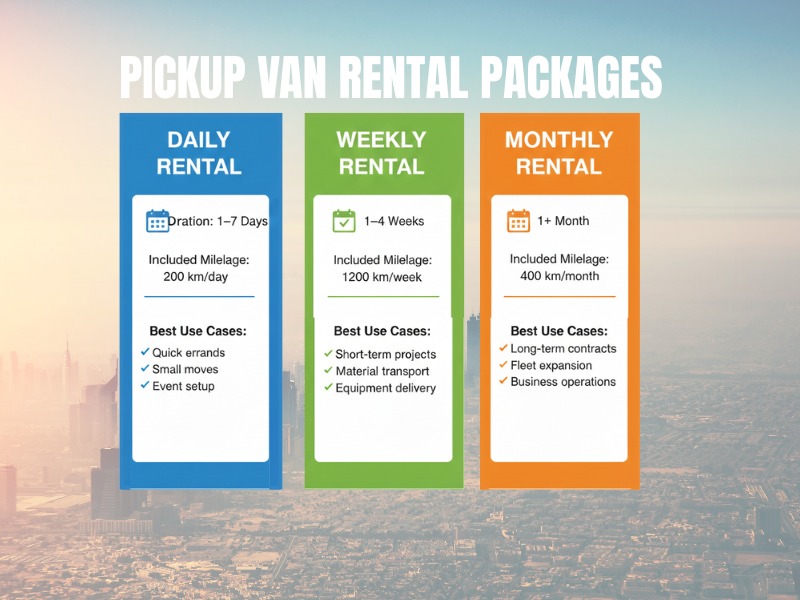
Rental flexibility matches business needs. Daily rates suit emergencies. Weekly packages fit short projects. Monthly contracts deliver the best value for regular operations.
Daily Rentals: Quick Solutions
Best for: Emergency transport, vehicle breakdowns, one-time deliveries, business testing
Cost: AED 250-450/day
Notice needed: 24-48 hours (same-day if available)
Mileage: 200-300 km included
Documents: UAE license, Emirates ID, credit card
Advantages: Maximum flexibility, no commitment, try before longer rental
Disadvantages: Highest per-day cost, limited mileage, booking uncertainty
Weekly Rentals: Project Perfect
Best for: Trade shows, renovations (1-4 weeks), month-end transfers, testing viability
Cost: AED 1,500-2,500/week (20-30% cheaper than daily)
Mileage: 1,500-2,000 km included
Terms: 7 consecutive days, comprehensive insurance
Example: A wedding planner rents weekly. Thursday delivery, Friday setup, weekend event, Monday breakdown, Tuesday return. Costs less than 3 daily rentals with the same vehicle throughout.
Monthly Rentals: Best Value
Best for: Established routes, regular deliveries, ongoing projects (6-12 months)
Cost: AED 3,000-6,500/month (40-50% cheaper than daily)
Mileage: Unlimited (most contracts)
Minimum: 30-90 days commitment
Included: Insurance, maintenance, 24/7 roadside assistance, vehicle replacement
Not included: Fuel, Salik tolls, traffic fines, excessive cleaning
Driver Options
With driver: +AED 150-250/day
Benefits: No hiring, no visa, insurance covered, professional training
Best for: Companies without drivers, temporary needs
Self-drive: Standard rates
Requirements: Valid UAE license (1+ year), age 21-25+, clean record
Best for: Existing driver staff, schedule control
Quick comparison:
| Duration | Daily Cost | Best For | Savings |
|---|---|---|---|
| Daily | AED 350 | Emergencies | Baseline |
| Weekly | AED 250/day | Short projects | 20-30% |
| Monthly | AED 135/day | Regular use | 40-50% |
Related: Need temperature control? Polar Freights offers chiller van rentals with the same flexible packages.
For comprehensive rental pricing details, visit our guide: 1 Ton Pickup Rental Price in UAE
Choosing the Right Pickup Rental Provider
Selecting the right pickup rental provider in the UAE is not just about price; it is about reliability, compliance, and operational continuity. A poorly maintained vehicle, unclear contract terms, or weak emergency support can disrupt deliveries and impact your business reputation.
This practical checklist, according to RTA regulations, helps you evaluate rental companies systematically, ensuring you choose a provider that meets safety standards, legal requirements, and service expectations across Dubai, Sharjah, and Abu Dhabi.
Conclusion
A 1 ton pickup van in UAE is one of the most practical transport solutions for small and medium-sized businesses managing daily deliveries, equipment transport, and warehouse distribution. Its balance of payload capacity, fuel efficiency, and maneuverability makes it ideal for operating across Dubai, Sharjah, and Abu Dhabi.
Whether supporting retail delivery routes or e-commerce logistics,our freezer truck rental provide the flexibility businesses need to keep operations running smoothly. Rental options allow companies to scale transport capacity without large upfront investment or long-term commitments.
For businesses transporting temperature-sensitive goods, chiller van rental in Dubai offers a reliable cold-chain solution alongside pickup transport.
Choosing the right vehicle for your logistics needs helps improve efficiency, control costs, and support long-term business growth across the UAE.
FAQs
What documents do I need to rent a 1 ton pickup truck in UAE?
You need a valid UAE driving license (minimum 1 year old), an Emirates ID copy, a credit card for a security deposit, and a contact number. Some companies require a passport copy for expats.
Can I drive a rented pickup truck to Oman or Saudi Arabia?
Most UAE rental companies restrict cross-border travel. Omani trips need special permission and insurance. Saudi Arabia typically prohibits. Always ask before booking.
Is fuel included in pickup truck rental prices?
No, fuel costs are typically excluded from rental rates. Most companies use a full-to-full policy. You receive a vehicle with a full tank and must return it full. Keep fuel receipts.
How much advance notice is needed to rent a pickup truck?
Daily rentals: 24-48 hours minimum. Weekly rentals: 3-5 days. Monthly rentals: 5-7 days. Peak seasons (Ramadan, year-end) need more notice. Same-day is sometimes possible if available.
Can I extend my rental period if needed?
Yes, extensions are possible if a vehicle is available. Contact the provider before the original return date. Extension rates may differ from the original booking. Early notice ensures vehicle availability.
What’s the difference between 1 ton pickup and 3 ton truck for my business?
1-ton pickups carry 800-1,000 kg, ideal for urban deliveries and tight spaces. 3-ton trucks carry 2,500-3,000 kg, better for bulk cargo. Pickups are more maneuverable and fuel-efficient. See the comparison section above.